The “Stochastic Parrot” Just Knocked on One of Math’s Biggest Doors
After a computer-verified proof of the Riemann hypothesis was announced on November 20, 2026, the claim that AI is merely a stochastic parrot is getting harder to defend.
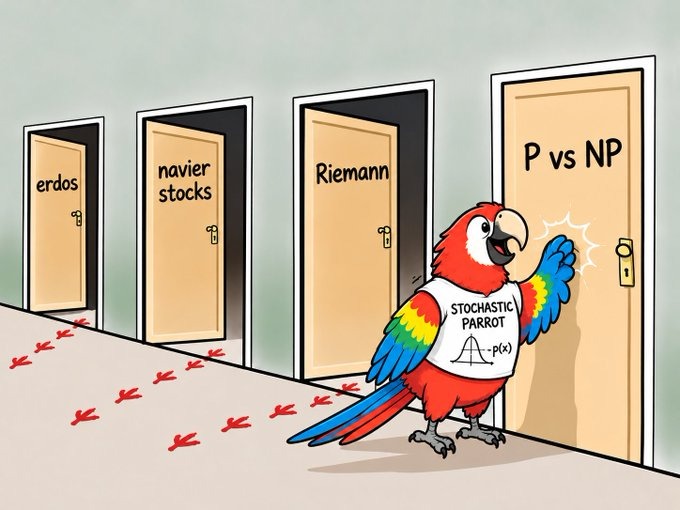
One of the main arguments against artificial intelligence (AI) being considered intelligent was that it was essentially a stochastic parrot. The rationale behind this argument was that AI relied on patterns found within its training data and therefore lacked the ability to discover new knowledge. The image above illustrates how this argument has become increasingly difficult to substantiate given the progression of AI over the past several years.
On November 20, 2026, mathematician Levent Alpöge announced that he and Anthropic’s Claude had found a proof to the Riemann hypothesis. The Riemann hypothesis deals with the distribution of prime numbers, which can be considered the building blocks of whole numbers. Although prime numbers appear to be distributed somewhat irregularly, Bernhard Riemann proposed in 1859 a hypothesis that would allow mathematicians to better understand the nature of their distribution. The difficulty and mathematical significance of this problem led to a million-dollar prize being allocated towards its solution.
To put the significance of this achievement into perspective, Terence Tao, who is widely considered one of the greatest living mathematicians, speculated in October that through the combined efforts of humans and AI the Riemann hypothesis could potentially be solved by 2050. 35 days after his interview a proof was announced.
What’s interesting about the progression of AI is how the argument against its capabilities changes as it becomes more capable. In 2023 AI struggled to reliably perform basic arithmetic. In 2024 it struggled with competitive high school mathematics and by 2025 it performed at the level of gold medalists in the International Mathematical Olympiad. However, critics argued that solving previously solved problems wasn’t indicative of an ability to discover new knowledge.
By early 2026 AI began solving relatively obscure open mathematical problems, followed by increasingly difficult university-level mathematics and eventually the disproof of an 80-year-old conjecture proposed by Paul Erdős.
Although humans played a significant role in solving the Riemann hypothesis by providing mathematical direction and developing the tools used to verify the solution, much of the technical work was performed by Claude. The proof consists of approximately 17 million lines of code and although its mathematical validity has been independently verified, understanding the entirety of the proof remains a challenge in itself.
The benefits of this achievement aren’t necessarily confined to mathematics. The real breakthrough isn’t that a math proof directly rewrites machine learning infrastructure, but that AI can now sustain long-horizon search when paired with automated verification. Formal math works well for this because a verifier can check every step against strict rules. That same pattern transfers to any domain where you can clearly test whether an answer is right: software tests, formal specifications, accounting rules, or scheduling constraints. Anywhere a reliable verifier exists, AI can explore huge numbers of possibilities and prove its work before a human ever has to review it.
As for what this means for everyday businesses, the upside won’t show up automatically. A frontier model proving a 167-year-old theorem doesn’t do much on its own for a fifteen-person service company or a local accounting firm. The real opportunity is taking that same combination of extended search and automated verification and building it into everyday workflows like invoicing, scheduling, inventory, and compliance. That is how you bend the median: not by keeping frontier breakthroughs inside research labs, but by turning them into dependable tools that typical businesses can actually use.
However, the benefits of AI shouldn’t be measured solely by the additional revenue it can generate for businesses. Its ability to reduce the amount of time people allocate towards repetitive work and potentially improve their standard of living may prove to be its greatest contribution to society.